Important Distinction: Admin vs. Wi-Fi Password
Before proceeding, verify which password you need.
- Wi-Fi Password: Used to connect devices (phones, laptops) to the wireless network.
- Admin Password: Used to log in to the router’s configuration page (usually
192.168.1.1) to change settings.- Note: This guide focuses on the Admin Password.
Method 1: Check the Device Label
Most modern routers have the unique default login credentials printed on the hardware.
- Locate the sticker on the bottom or back of the router.
- Look for fields labelled:
- Default IP / Access: (e.g.,
http://tplinkwifi.netor192.168.0.1) - Username: (e.g.,
admin) - Password / PWD: (e.g.,
passwordor a random string likeaB3dEf)
- Default IP / Access: (e.g.,
Method 2: Common Default Passwords
If the label is missing or unreadable and you have not previously changed the password, attempt the standard default credentials for your manufacturer.
Common Default Combinations:
| Manufacturer | Default IP Address | Username | Password |
| TP-Link | 192.168.0.1 / 192.168.1.1 | admin | admin |
| Netgear | 192.168.1.1 | admin | password |
| ASUS | 192.168.1.1 / 192.168.50.1 | admin | admin |
| Linksys | 192.168.1.1 | admin | admin |
| D-Link | 192.168.0.1 | admin | (leave blank) |
| Cisco | 192.168.1.1 | cisco | cisco |
| Verizon / AT&T | 192.168.1.254 | admin | (see device label) |
Note: If these do not work, the password has likely been changed by a user. Proceed to Method 3 or 4.
Method 3: Check Saved Browser Passwords
If you have logged in before, your web browser may have stored the credentials.
Instructions for Google Chrome / Edge:
- Open browser Settings.
- Navigate to Autofill > Password Manager.
- In the search bar, type
192.168or10.0. - If a result appears, click the Show (Eye Icon) to reveal the saved password.
Method 4: Factory Reset (Hard Reset)
If the password is lost and cannot be recovered, the router must be reset to factory defaults.
⚠️ CAUTION: This process will erase all current settings, including:
- Wi-Fi Network Name (SSID) and Password.
- Internet Provider (PPPoE) login details.
- Port forwarding and firewall rules.
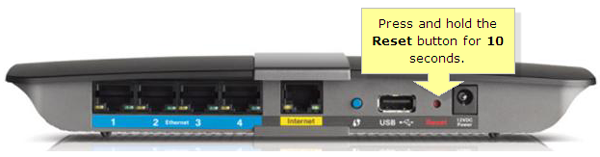
Reset Procedure:
- Power On: Ensure the router is connected to power.
- Locate Button: Find the
ResetorRSTbutton (usually a small recessed hole). - Press and Hold: Insert a paperclip or pin. Press and hold the button for 10 to 15 seconds.
- Observe Lights: Release the button when the LED lights on the front panel flash or when the system restarts.
- Re-configure:
- Wait 2 minutes for the router to reboot.
- Connect to the network using the info on the device label.
- Open a browser and go to the default IP (e.g.,
192.168.1.1). - Log in using the default credentials (e.g.,
admin/admin).
Troubleshooting Login Issues
Problem: The Reset did not work (the Old password is still active).
- Cause: The reset button was not held long enough.
- Solution: Repeat the reset process. Hold the button for 30 seconds specifically.
Problem: Cannot access the login page (Page not loading).
- Cause: Device is not connected to the router or is using a static IP.
- Solution:
- Ensure your computer is connected to the router via Ethernet cable or Wi-Fi.
- Set your computer’s IP settings to “Obtain an IP address automatically” (DHCP).
- Try a different browser (e.g., use Firefox instead of Chrome).
Problem: The Default password is rejected after reset.
- Cause: Browser cache or incorrect default data.
- Solution: Clear browser cache or open an Incognito / Private window and try again. Double-check the physical label on the device.